Your fleet is 4 vendors. Botpylon sees one.
Mixed-vendor robot fleets are the norm in modern fulfillment. The problem is that each vendor's fleet management software only talks to its own hardware. Botpylon is the middleware layer that normalizes them all into a single unified dispatch surface.
Mixed fleets break vendor dispatch software
A 3PL running three robot vendors ends up with three fleet management dashboards, three dispatch queues, and zero coordination between them. Each vendor's software is optimized for its own hardware. None of them know the others exist.
The result: AMRs from vendor A hold a path intersection while AGVs from vendor B queue behind it. Neither system can see the other's state. The congestion is invisible to both, and human operators are the only coordination layer, until the floor is running 50+ robots per zone and operator attention can't scale.
Botpylon does not replace your robot vendor's fleet management software, and it does not sell robots. It sits above the vendor layer, ingesting telemetry state from every fleet controller simultaneously and dispatching unified task assignments that account for every robot on the floor, regardless of manufacturer. Your vendor relationships stay unchanged. The missing coordination layer gets added.
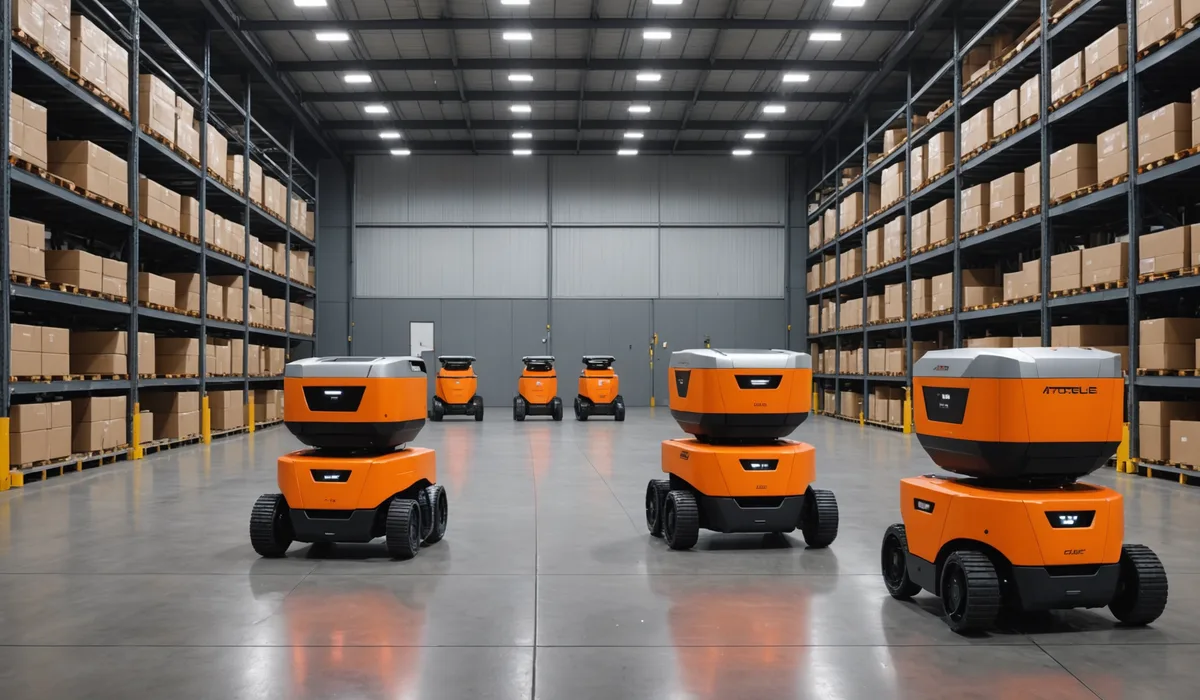
Supported robot types
Botpylon's adapter layer normalizes telemetry and task interfaces across major robot categories. Fleet size supported: 1 to 500+ robots per floor.
Autonomous Mobile Robots
Self-navigating AMRs with onboard SLAM, typically exposing REST or WebSocket APIs. Botpylon ingests position, velocity, battery, and task state. Dispatch assignments are pushed via the adapter without requiring firmware changes on the robot.
Automated Guided Vehicles
Fixed-path AGVs with magnetic tape, QR markers, or wire-guided navigation. Botpylon treats AGVs as constrained-path nodes in the floor graph, routing AMRs around their fixed lanes and coordinating zone entry timing to prevent AGV-AMR conflicts.
Collaborative Picking Arms
Stationary robotic pick arms at specific stations are modeled as fixed-throughput nodes. Botpylon manages the inbound queue of mobile robots delivering totes to the arm, preventing robot clustering at pick station entrances during peak throughput periods.
Conveyor Systems as Nodes
Conveyor induction and discharge points are modeled as time-gated nodes in the floor graph. Botpylon schedules robot handoffs to conveyor at the correct cadence, avoiding induction jams when multiple robots arrive simultaneously at a high-speed sortation line.
What happens when things go wrong
Fleet events trigger immediate optimizer recalculation. Botpylon handles the operational edge cases that cause human dispatchers to intervene.
Robot goes offline mid-task
Task is immediately returned to the pending queue and reassigned to the nearest available robot within one optimizer cycle, typically under 10 seconds. No manual intervention required.
Zone congestion spike
Congestion predictor detects rising zone density and raises edge weights for affected aisles. New dispatch assignments route around the congested zone. Robots already en route are not diverted unless the congestion is severe enough to justify the reroute cost.
Priority order enters the system
High-priority tasks are inserted at the top of the task queue and the optimizer recalculates assignments. A robot within range may be reassigned from a lower-priority task to the priority pick, with the displaced task rescheduled based on current floor state.
Robot battery below threshold
Botpylon tracks battery state for all robots and pre-emptively routes low-battery robots to charging stations during task transitions, not mid-aisle, minimizing floor disruption from charging cycles.
Tell us your fleet mix. We'll show you the topology.
Share your robot vendor list and floor plan. We'll model how Botpylon would coordinate your specific mix and show you the expected congestion reduction.
Request Demo